I still remember back when I was a kid, I used to make paper aeroplanes with the business flyers I found in the newspapers. At that time, marketing was very limited to a few things like posters, flyers, word of mouth or TV ads if your business is at an all-time high. But in today’s world, marketing is a very broad subject. It has expanded from word of mouth to websites, from TV ads to much cheaper Facebook and Google ads. I never expected to learn human behaviour in a sales class. Let’s discuss this in more detail. Just 10 years ago, businesses used to give ads in newspapers, radios and TV, billboards, etc., and today businesses prefer to promote their brand online on social media, websites, digital flyers, Google Ads, etc. We can clearly see the change in the industry. Now the question is, which one is best for businesses in 2025?
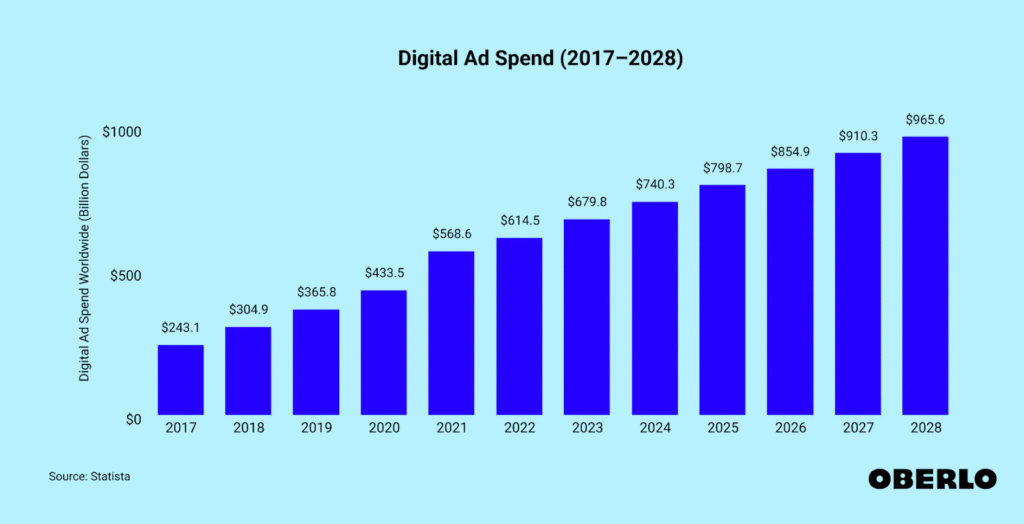
This image shows how much digital ad spend is expected in 2028 (OBERLO)
As we can see, global ad spend is expected to reach nearly $ 1,000 billion in 2028. The same is with social media. According to Google, there are 5.24 to 6.04 billion users on social media platforms.
Now that is the exact reason why any business should pursue online marketing in 2025, but ignoring traditional marketing will also be a foolish decision. Here’s why.
Defining Traditional Marketing
Traditional marketing is a tactic used to market products and services to a targeted audience. Traditional marketing encompasses offline methods, including printed flyers, word of mouth, TV ads, radio ads, posters, and billboards. Those marketing materials are usually placed in locations where their target audience is most likely to notice them. These methods of marketing are still valid. Businesses can reach their targeted audience using these methods. Because this method includes: (geeksforgeeks)
Offline Channels
Less Segmentation
Strong Relationships
Brand Recognition
Big companies, as we all know, use these tactics. But every coin has two sides. So there are some disadvantages of traditional marketing, like: (geeksforgeeks)
Global advertising and marketing spending reached $841 billion in 2024, with combined online and offline revenue projected to surpass $1.87 trillion by 2025.
The average cold call success rate in 2025 is 2.5%
Thursday is the best day for cold calls, driving the highest number of meetings booked.
The U.S. B2B trade show market is forecasted to hit $15.8 billion in 2024.
TV consumption continues to decline — only 56% of U.S. adults watch 3+ hours of traditional TV daily, down from 61% in 2024.
Defining Online Marketing
online marketing is a more advanced and technological version of traditional marketing. In online marketing, instead of offline and traditional channels, we use online and social channels. It all started in the 1990s with the internet boom. Now every home, every office, every business has access to the internet. Because of that, businesses started to promote their products and services online on the internet instead of traditional channels. The first-ever online marketing channel is email marketing, and today it has evolved to a $780 billion industry, which is expected to reach $1.9 trillion in 2030.
In online marketing, we have a vast variety of markets. Every segment is so big that you can specialise in it.
Website marketing:
Creating a website for a business. Creating content on it and making it rank on Google. A website is like a shop, but on the internet. A website contains additional information about the business and what products or services it offers, along with the contact information.
SEO:
Seo stands for “Search Engine Optimisation”. It means to optimise the content on our website to visually rank higher on Google. A website without SEO will never get noticed. It drives organic traffic and customers to the business.
Email Marketing:
Even in today’s time, email marketing is one of the most effective ways to promote your business online. It means to use other channels to collect names and emails of the targeted audience and then send them an email about the business’s products or services.
Social Media Marketing:
Social media marketing is used to create awareness about the business, and it uses social platforms like LinkedIn, Facebook, YouTube, Instagram, and Twitter (X) to promote products or services.
These are just 4 channels, but this is a very vast subject to dive in.
online marketing continues to dominate online visibility, with search engines driving 93% of website traffic, and the global industry is projected to exceed $740 billion in 2024.
46% of Google searches have local intent, and 88% of mobile users visit a business within 24 hours of a local search.
Search advertising remains the largest segment within digital marketing, with a projected volume of $202.4 billion.
Key Differences Between online and Traditional Marketing
Point
Traditional marketing
online Marketing
Audience reach
It has more local and regional reach
It has a global reach
Cost
Expensive compared to digital marketing
Cheaper and more cost-effective
Speed
Needs more planning and time to execute
Can be executed quickly
Flexibility
Campaigns are often set in stone once launched
Campaigns are easily adjusted quickly
Sharability
Content is not shareable
Digital content can be easily shared
Lead generation
Requires more brand recognition
Can generate leads quickly
Pros and Cons of Traditional Marketing (simplilearn)
PROS
If you want to reach an older demographic, traditional marketing can be very effective. It has been reported that audiences ages 50+ spend almost twice as much time reading the newspaper and watching TV as compared to those ages 21-34.
This type of marketing strategy usually works best for businesses looking to build a larger local audience. A small business would be better off competing for attention through billboards, flyers, and events rather than trying to compete for digital space against larger businesses.
TV or radio commercials will play multiple times and remind the audience of the business, whereas digital marketing items may be skipped through or blocked.
CONS
Printing postcards to send out, even to just a local audience, can be expensive, and there is no guarantee that the recipient is interested in your business or the product/service you offer.
Traditional marketing methods can take weeks or months to yield results and data. You can’t tell when someone has read your newspaper ad unless they decide to follow up. Even then, without a survey, you won’t know if the ad was the reason for the follow-up.
Data and audience involvement can be tracked instantly. When someone clicks on a link to your site, reads an email, or follows you on social media, you have that information immediately. You can draw numerous insights from this data, including which type of content works best for a specific audience, which mediums are the most effective, and even what time of day receives the best engagement.
Digital marketing strategies incur a much lower cost. Sending out an email campaign can save a lot of money compared to printing individual postcards and paying for postage on each.
It works well for more global or scattered audiences because of the broad scope of digital marketing.
Cons
Some internet users have ad blockers, so they’ll never see pop-ups or banner ads. Other times, ads can be skipped or removed if a user pays for premium services.
Because new technology and trends emerge so frequently, digital marketing tactics need to be evaluated and reevaluated for effectiveness continually what works well one day may be irrelevant the next. However, this can be combatted with a strong foundation in digital marketing basics.
Conclusion: Choosing What Works for Your Brand
With everything that has been stated so far, the question is which one to use. Both are excellent in their own segment.
For most businesses, digital marketing is the best option because it’s cheap, quick, easy and less time-consuming. It gives you data about your own business.
However, there is still a place for traditional marketing. If you want to reach an older audience or a local audience, traditional marketing methods may be more useful than digital marketing methods. Though these methods may seem old, the reality is that they’ve stuck around for a reason. They work!