
Landing Page Design System
The Blank Canvas Problem
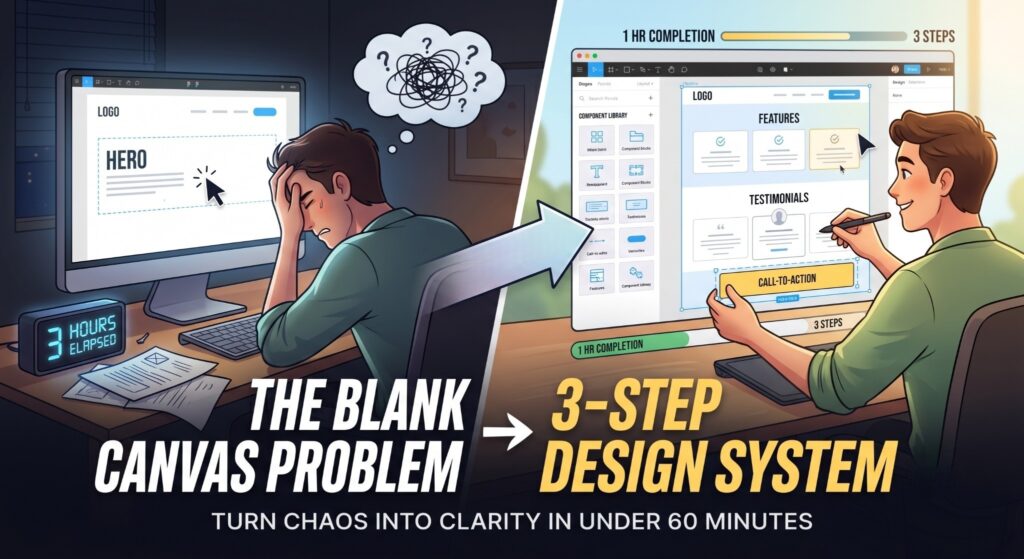
You are staring at a blank Figma file. The cursor blinks. Three hours evaporate, and all you have is a header with a logo and a half-hearted hero section. Sound familiar? Every web designer has been there, trapped in the cycle of starting from scratch every single time. What if there was a 3 step effortless landing page design system that eliminated the blank canvas problem forever?
The truth is, most designers treat every landing page like a bespoke masterpiece, handcrafting each pixel from zero. That approach does not scale. It burns time, drains creativity, and leaves clients waiting. A 3 step effortless landing page design system flips the script entirely, giving you a repeatable, lightning-fast framework that turns chaos into clarity in under sixty minutes. This system is not just theory; it is the exact methodology behind the 3 step effortless landing page design system that top agencies deploy every day.
Why Most Designers Get It Wrong
According to the Nielsen Norman Group, a design system is a set of standards to manage design at scale by reducing redundancy while creating a shared language and visual consistency across different pages and products [1]. Yet, most freelancers and agencies still build landing pages like one-off art projects. They open a blank canvas, browse Dribbble for inspiration, and cobble together a layout from scratch. Each project becomes a reinvention of the wheel.
The consequence is staggering. A typical landing page takes twenty to forty hours from concept to delivery. Multiply that across ten client projects a month, and you are looking at
a full-time workload just on landing pages alone. There is a better way. The 3 step effortless landing page design system compresses that timeline into a single focused session, what top designers call a 60 minute bulletproof workflow for landing pages.
Leadpages notes that a landing page framework ensures each page includes the elements your visitors need to convert, from compelling headlines to effective calls-to-action [2]. Instapage identifies eight core elements of a great landing page framework: compelling headline, effective copy, engaging media, trust indicators, lead capture form, strong CTA, social proof, and a distraction-free design [3]. These are not random ingredients; they are the structural DNA of conversion. When you codify them into a system, you design 10x faster with a seamless landing page framework.
Step 1: Foundation — Your Brand DNA
Design Tokens and Visual Identity
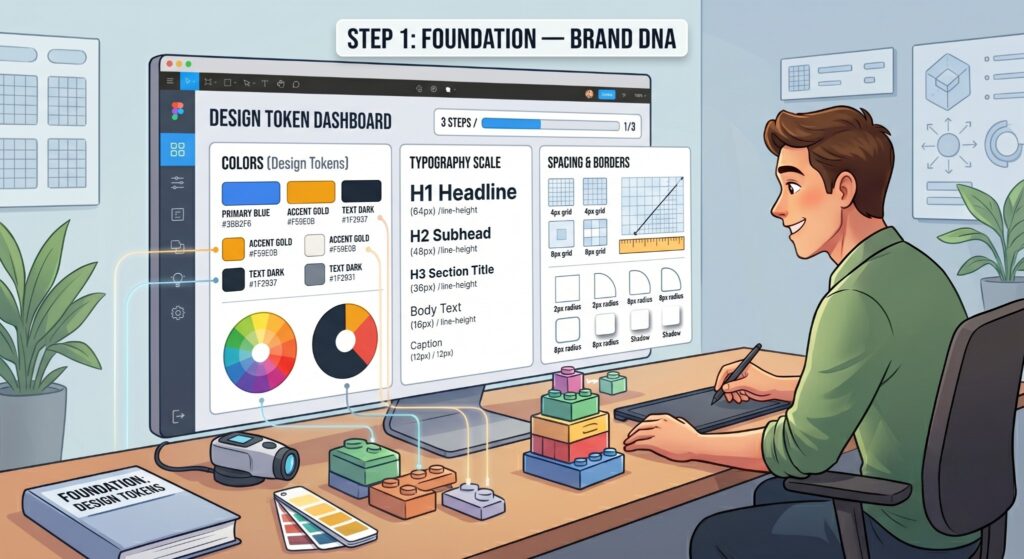
Every great building starts with a foundation. In the 3 step effortless landing page design system, your foundation is a set of design tokens: colors, typography scales, spacing units, and border radii. Think of them as the genetic code of every landing page you will ever build. Instead of picking a shade of blue from scratch each time, you pull from a pre-defined palette. Instead of debating font sizes, you follow a type scale.
This is not about being rigid; it is about being intentional. When your foundation is locked in, every decision downstream becomes faster because the options are already curated. A design token system typically includes primary and secondary colors, a typographic hierarchy with five to six levels, spacing values on a four or eight pixel grid, and standardized shadow and border treatments. Once these tokens are defined, you never agonize over them again. This is the first secret of how to build 1 insane design system for client sites.
Step 2: Components — Building Blocks That Snap
Modular Architecture for Speed
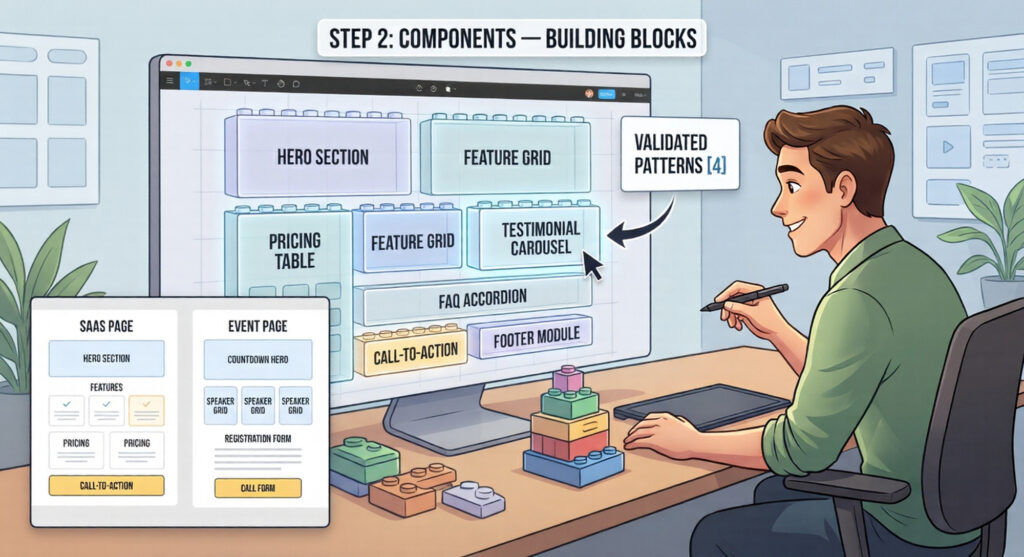
With your foundation in place, step two of the 3 step effortless landing page design system is assembling a library of reusable components. These are not abstract design patterns; they are tangible, production-ready building blocks: hero sections, testimonial carousels, pricing tables, feature grids, FAQ accordions, and footer modules. Each component is built from your design tokens, ensuring visual coherence across every landing page you produce.
The magic of this step lies in composability. Want a SaaS landing page? Combine a hero section with a feature grid, a pricing table, and a CTA footer. Need an event page? Swap in a countdown hero, a speaker grid, and a registration form. Each component snaps into place like Lego bricks, because they all share the same underlying grid, spacing system, and visual language. This modular approach is exactly how to build 1 insane design system for client sites that actually scales.
Framer highlights that the best landing page practices leverage psychology and proven patterns rather than reinventing layout decisions [4]. When your components are pre-validated against conversion data, you are not guessing; you are deploying battle-tested solutions. That is the power of the component layer.
Step 3: Assembly — The 60-Minute Workflow
From Brief to Delivery in One Session
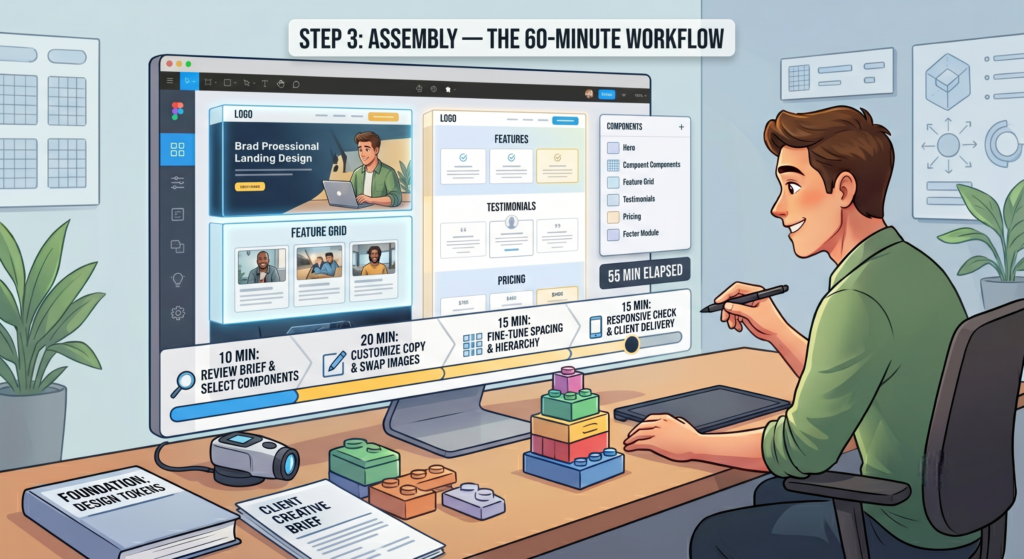
This is where the 3 step effortless landing page design system delivers its knockout punch. You have your tokens. You have your components. Now you assemble. The 60 minute bulletproof workflow for landing pages breaks down like this: ten minutes to review the creative brief and select the right components, twenty minutes to customize copy, swap imagery, and adjust token values for the specific brand, fifteen minutes to fine-tune spacing and visual hierarchy, and fifteen minutes for responsive checks and client presentation.
That is not a fantasy. It is the workflow that elite design agencies use to ship landing pages at scale. The key insight is that assembly is not design; it is configuration. All the creative heavy lifting happened in steps one and two. Step three is pure execution speed. This is one of the 3 secrets to elite web design scaling: separate the creative decisions from the production pipeline, and you unlock throughput that most designers cannot even imagine.
When This System Is Not the Right Fit
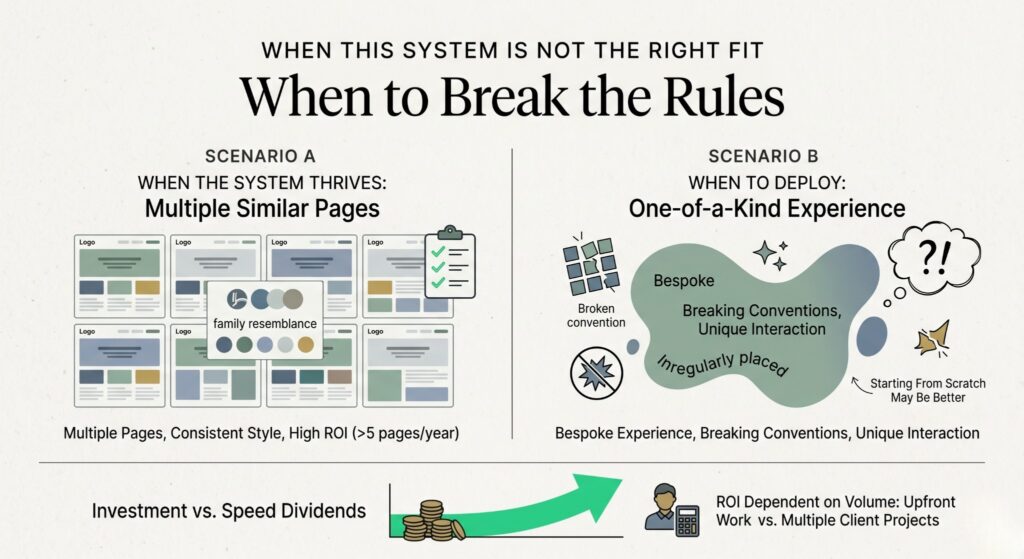
No framework is universal, and honesty demands acknowledging the edges. The 3 step effortless landing page design system thrives when you are producing multiple landing pages that share a family resemblance. If you are designing a one-of-a-kind interactive experience, an immersive brand activation page, or something that deliberately breaks conventions to make a statement, starting from scratch may genuinely serve the project better.
Additionally, building the system itself requires an upfront investment. Steps one and two might take twenty to thirty hours of focused work before you see the speed dividends in step three. For a freelancer with only one or two landing page projects a year, that investment may not pay off. But for anyone producing five or more landing pages annually, whether for different clients or for your own product launches, the return on investment is undeniable. As the Design Systems Collective notes, a design system should streamline development by reducing the code developers need to manage [5].
Scale Your Design, Not Your Stress
The 3 step effortless landing page design system is not just a productivity hack; it is a paradigm shift. By separating your work into foundation, components, and assembly, you transform the chaotic, open-ended process of landing page design into a structured, repeatable, and blisteringly fast workflow. You stop reinventing the wheel and start refining the machine.
If you have been grinding through every project from scratch, it is time to build your system. Define your tokens. Craft your components. Master the assembly. That is how you design 10x faster with a seamless landing page framework. That is how you discover the 3 secrets to elite web design scaling. And that is how you turn the blank canvas from a source of dread into a launchpad for excellence.
References
[1] Design Systems 101 — Nielsen Norman Group
[2] Master Landing Page Framework for Sales Success — Leadpages
[3] 8 Most Important Elements of a Landing Page Framework — Instapage
[4] 9 Landing Page Best Practices for 2025 — Framer
[5] What Does Scaling a Design System Mean to You? — Design Systems Collective
very nice and useful information…. keep it up
very nice and useful information
very nice and useful information. keep it up
very nice and useful information.
Hey , i just read and visit to ur blog page it have a useful information and ideas keep going dude 👍🏻🙌🏻😃
Pingback: The Ultimate Guide to What UI/UX Design Is in 2026 - VINMARK